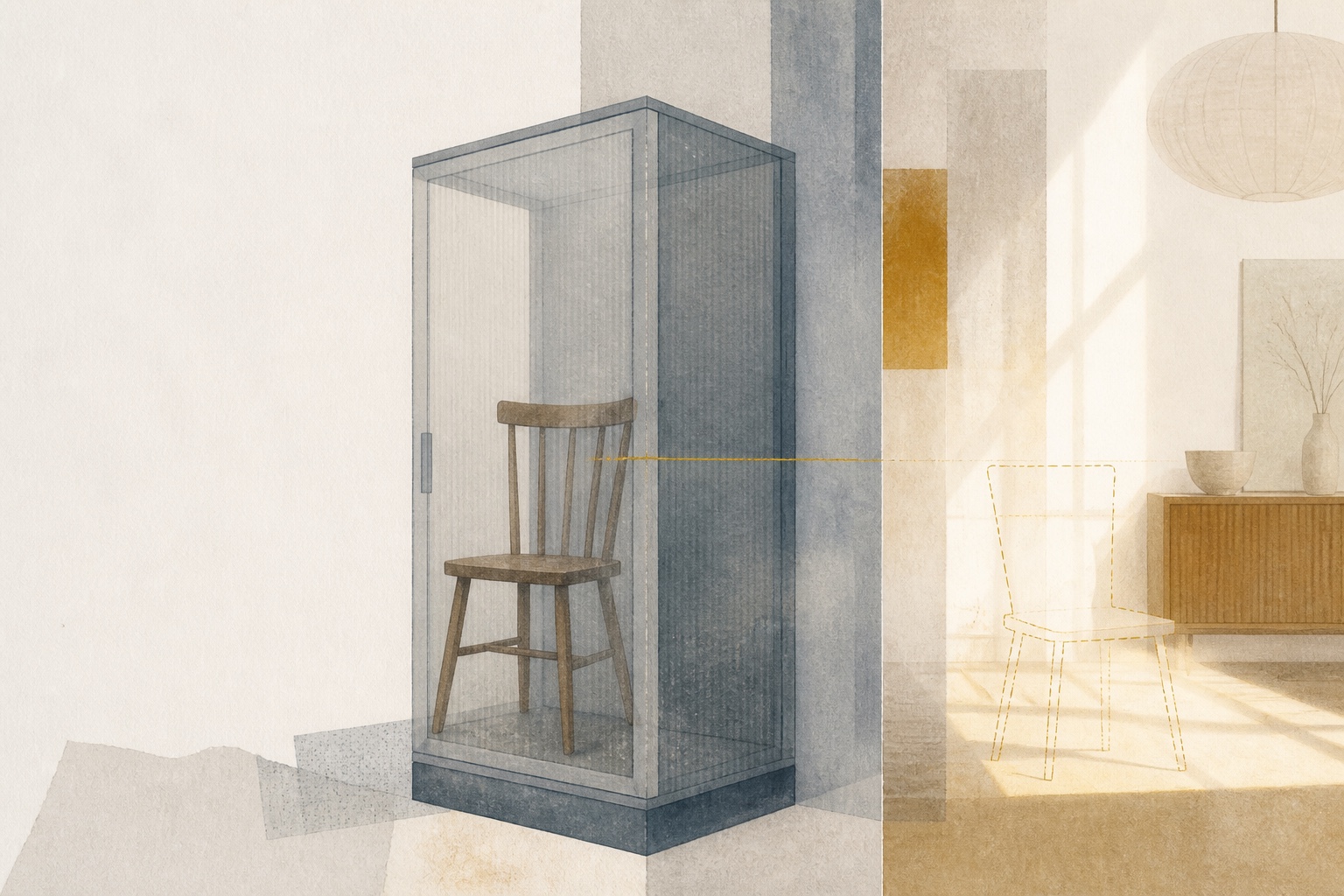

One sealed-off room. After the clear-out: fifty-one bags of rubbish, zero bags for recycling, one bag to give away.
Zero recycling bags doesn’t mean there was nothing recyclable in the room. The scope of work that day was limited: the owner wouldn’t allow items to be moved freely, and saying “throw it away” directly in front of him was off the table. But one thing was plain: this household held onto things with extraordinary care. Every one of the daughter’s textbooks and exercise books was kept intact. Objects had been preserved for years. In the end, nearly all of them left as rubbish.
People tend to imagine an object’s expiry as the day it breaks. In practice, an item can become very difficult to pass on to the next user long before any obvious damage appears.
Idleness first freezes a resource, then slowly consumes it
When something isn’t being used, nothing seems to be happening. It sits in a box, a cabinet, or a corner, waiting for the day it’s needed again. The trouble is that an item’s reusability doesn’t stay completely frozen just because no one touches it.
Cosmetics, food, medicine, and cleaning products carry expiration dates that begin counting down from manufacture or first opening. Electronics and digital devices depend on compatible plugs, cables, consumables, repair support, and specifications that may eventually be discontinued. Paper can absorb moisture, fabric can mould, timber can be eaten by insects. Store things in an unventilated space with layers of objects piled on top, and environmental wear accelerates.
The period when an item stays in place can be thought of in two phases. First, its value is frozen: the item could still be used, but nothing is moving. Then storage conditions and elapsed time begin to erode reusability. There’s no alarm between the two phases, which makes it easy to assume that “not yet broken” means “still time to sort it out later.”
A few years earlier, it could have been given away. A few years later, only removal is left.
The same pattern appears in organizing situations repeatedly. One professional unpacked online shopping boxes that had never been opened; most of the skincare inside had expired two or three years prior, and a premium fragrance had oxidised before it was ever used. These items didn’t lose their value through overuse. They lost it by never being used at all.
One family’s factory kitchen was stocked with expired sauces. Another household’s beauty products sat until they passed their dates. Someone described having to step around clutter just to reach the refrigerator when guests arrived, and then not being sure whether the drinks inside were still safe to consume. Idleness didn’t preserve the original function of those objects; it only pushed the moment of reckoning further away.
These cases come from different households and different categories of goods. They aren’t a longitudinal study tracking the same batch of items across years. What they support isn’t a statistical claim but a practical observation about timing: the later an item is finally examined, the fewer reuse options tend to remain.
An object’s lifespan is not a single fixed line
Items with expiration dates have the shortest window. Fresh food is counted in days or weeks; packaged goods, cosmetics, and cleaning products each carry their own dates. Once expired, an item can’t be used, and passing it on to someone else may not be appropriate either.
Items with specification or style limits include electronics, digital devices, clothing, and toys. They may not have failed outright, but if parts, consumables, or a fitting use case can no longer be found, the practical lifespan is shorter than it first appears.
Construction materials, furniture, complete book sets, and tableware tend to have more stable specifications and may keep longer, yet they face a different problem: too large to move easily, or no accessible channel to pass them on through. A batch of floor tiles stored for twenty years ended up being listed online by the owner because the material was stable and hadn’t absorbed moisture. A treadmill kept for over a decade with no obvious fault was eventually dismantled and sent for recycling, because its size, the effort of moving it, and the difficulty of finding a recipient within a short window made any other outcome impractical.
“Still usable” answers a question about condition. It doesn’t answer whether the item can actually circulate. Reusability requires looking at storage, use, repair, and handoff together.
Deciding when to act is itself part of resource efficiency
The last time an item is used is usually a good moment to reconsider where it should go next. Not every object unused for a year needs to leave immediately, and not every long-stored item has necessarily expired. The question is whether a clear use case, adequate storage conditions, and a realistic recipient still exist.
Decide a few years earlier, and an item is more likely to reach someone as a usable object. Wait a few more years, and what remains may be a removal fee and the burden of disposal. Circular economy thinking isn’t about keeping everything. It’s about giving objects a chance to be used again before they lose their function, and routing them back into materials or final disposal only when reuse is genuinely no longer possible.
Things don’t have to break to lose their value. Sometimes an object is simply stored too long. Long enough that the next person who might have needed it can no longer find it, and the object itself can no longer find its way out of the room it’s been left in.

💬 Comments
Loading...