PAUL KUO · PROJECTS · 2024 –
CircleFlow
AI-driven data infrastructure for the circular economy, making the flow, value, and ownership of resources visible, traceable, and governable again.
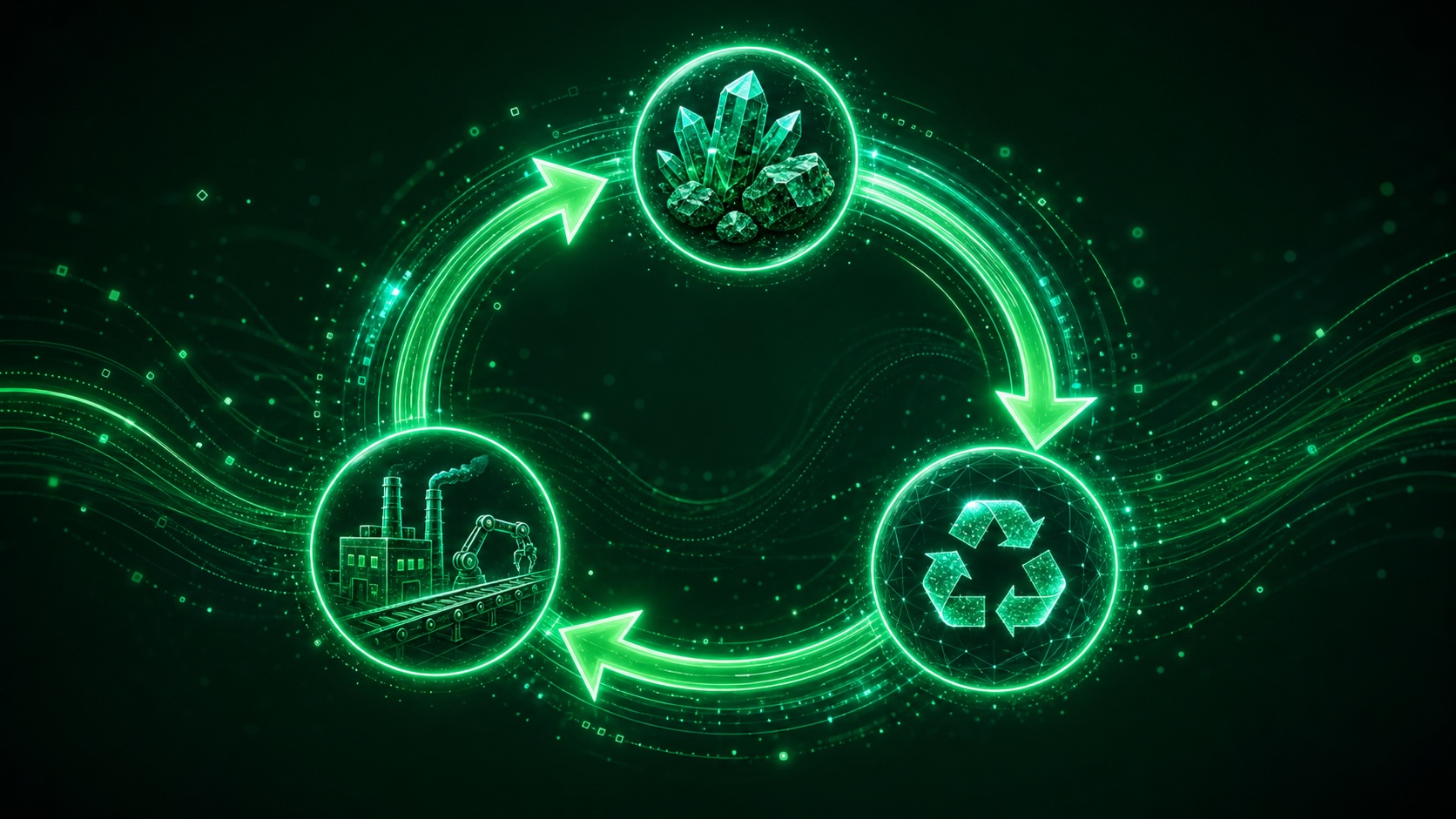
The linear model of industrial civilisation is exhausting its material base.
CircleFlow is not only about matching waste with takers. It is about rebuilding a material order:
so that the flow, value, and ownership of resources become traceable, trustworthy, and governable again.
What this project does
The circular economy has been discussed for years. What keeps stalling it is not intention but data. Once an object leaves its user’s hands, where it went, what it became, and who is responsible is a broken line in most industries. Yet the rules of recent years, from the EU’s carbon border adjustment and product environmental declarations to California’s supply-chain disclosure, ask precisely for verifiable data along that line.
CircleFlow sets out to build that line itself: data infrastructure that lets material flows be recorded, reconciled, and reported. Three words describe its scope.
Visible
Where an object goes after it leaves its user is, today, mostly a broken line. Drawing the flow comes before anything else.
Traceable
The flow has to be reconstructible: from a household’s disposal decision to collection, remanufacturing, and reporting on the industry side, every segment must leave records that reconcile.
Governable
CBAM, LCA, EPD, and extended producer responsibility all ask for the same thing in the end: material-flow data that can be verified.
Starting at home: after decluttering
The first segment of a material flow is not in a factory but at home. The moment something is judged “no longer needed”, its flow begins. The series “After Decluttering | How Objects Move Again” covers exactly this segment: how objects come in, how they are placed in a space, how a family cares for them, and how they finally move again through institutions. It is the household-facing half of CircleFlow.

Series
After Decluttering | How Objects Move Again
- Object Entry13 articles
- Spatial Systems15 articles
- Family Care20 articles
- Circulation Systems12 articles
60 articles in four parts.
Enter the series →Up to industry: rules and data
The other end of a material flow is institutions. These articles discuss what the same line demands on the industry side: data sovereignty, how life-cycle assessment turns into a compliance system, and where supply-chain disclosure pushes responsibility. They are the industry-facing half of CircleFlow.
- What Industry Conditions Are Still Missing Before Agricultural Residues Become Products?
Pineapple leaves and spent mushroom substrate both have the potential to be reused. For materials to keep reaching market, specifications, logistics, and buyers need to work together, while clear calculation boundaries test environmental benefits.
- LCA Is Not Just Science, It's a Compliance System: Fifty-Six Years of Evolution from Coca-Cola 1969 to CBAM 2026
From Coca-Cola's internal defensive study in 1969 to CBAM entering its definitive phase in January 2026, LCA has traveled fifty-six years. This article chronologically traces the formation of standards systems such as ISO 14040, ILCD, LCDN, and EPD, showing how each technical concept corresponds to a moment of political pressure or regulatory change, and revisits how the 2015 Volkswagen Dieselgate scandal transformed the entire logic of regulation.
- EPD and Carbon Footprint Implementation Roadmap: From a Four-Layer Framework to a Manufacturer's Action Checklist
The previous article explained why LCA is a compliance system rather than science; this one tackles the implementation problem: CBAM has entered its definitive phase as of 2026/1/1, and manufacturers without an EPD will be assigned higher default values. This article breaks down, by the four-layer framework (method/standards/data/certification), how a manufacturer should go from zero to a first EPD, including a timeline rhythm of 8–18 months, a budget range of NT$500,000–5,000,000, and a management decision checklist.
- Three Carbon Prices in the Same Supply Chain: 5 Transactions Isn't Market Failure. It's the System Telling You to Cut Emissions Yourself
Taiwan's carbon exchange recorded only 5 trades in its first 1.5 years, and many have read that as market failure. But SSBTi's position and Prof. Tung Ching-Pin's analysis are clear: the NT$300 carbon fee was designed to force companies to reduce emissions themselves, not to push them into buying credits. Three carbon prices in the same supply chain (NT$300 / NT$3,000–4,000 / CBAM ~NT$2,790) fracture corporate readiness, not policy logic. The real solution is a carbon-economy mindset + third-party verification + the TNFD/SBTi/CDP triple track, not more carbon credits.
- Even If You Don't Export to the EU, You Can't Escape: What CBAM Really Tests Isn't Calculation. It's Your Carbon Data Sovereignty
CBAM formally enters its levy period in 2026, with the aluminum industry's additional cost at roughly 3.83% of the aluminum price, climbing to 6% by 2028 once the default value mark-up is included. But the real damage isn't in the numbers. It's that if a company can't produce its own actual measured data, it can only let its competitor set its price. This article breaks it down from the perspective of Taiwan's supply chain: CBAM is a supply chain management problem, not a calculation problem.
- California SB 253 Is Reshaping Corporate Carbon Disclosure: Why Apple and Tesla's Rankings Plummeted, and Where Taiwan's Supply Chain Fits
California SB 253 formally entered its enforcement phase in February 2026. Once Scope 3 is included, Apple's ranking falls 35 percentile points and Tesla's falls 50. How does this law reach every node of Taiwan's supply chain through procurement contracts?
- Four Hundred Thousand Footsteps: How Much Carbon Do They Offset?
The 2026 Baishatun Mazu Pilgrimage introduced a GPS carbon footprint tracking system for the first time, combining the SSBTi science-based carbon reduction framework with a nine-tier gamified pilgrim ranking system. The project attempts to document the low-carbon significance of 400,000 pilgrims' walking behavior in a modern, data-driven way. Emission factor: 0.21 kg CO₂/km; estimated avoided emissions: approximately 6,300 tonnes of CO₂. A cross-disciplinary experiment, still unfolding.
- Taiwan Semiconductor's 10x Leap: When Capital Meets Innovation Clusters
Taiwan's semiconductor competitiveness stems from the high degree of synergy between capital, technology, and industrial clusters. The next wave of growth won't happen only in advanced processes, but in the integration capabilities of resource reallocation, circular economy, and cross-border collaboration. A 10x leap isn't linear expansion, but structural reconstruction.
Where things stand
The CircleFlow platform itself is still exploratory; there is no publicly available product. What is public today are the two layers above: the household-side series and the industry-side policy articles. This page will be updated as the project moves on. Until then, it is the shared entry point to both.
All projects:/en/projects/