
Late last month, a 2026 global AI usage distribution chart exploded across social media. It’s already made several rounds through my circle of friends, and each time I see it, it stirs a different reflection.
This chart lays out the AI usage status of 8.1 billion people as one giant mosaic of colored blocks. The visual is intuitive, and the impact is immediate: 84% of people have never truly used AI. About 16% have used a free chatbot. Those willing to pay $20 a month to subscribe to an AI service make up only about 0.2% to 0.3%. And those actually using AI coding tools number roughly 2 to 5 million worldwide, less than 0.05%.
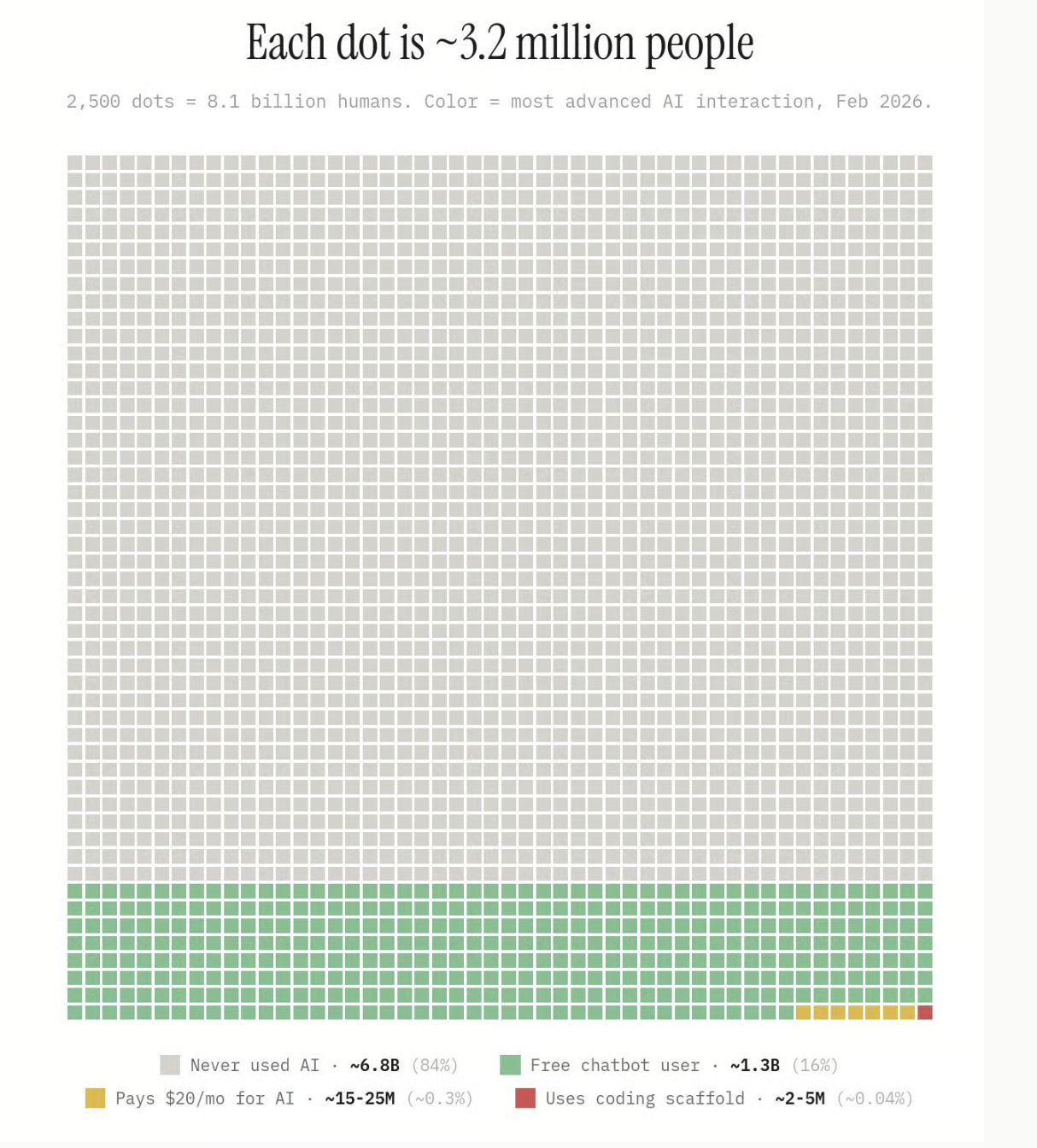
The most important thing about this chart isn’t just that it makes you marvel at how lopsided the proportions are. It forces you to confront a few questions: Which colored block are you in right now? How do you plan to move to the next one? Which block are your customers in? Are you ready to enter this extreme world?
There’s a more accurate way to read this chart: it’s a capability map.
The World of Spectators
Many people’s understanding of AI remains stuck in a kind of “spectator state.” They know the names Gemini, OpenAI, Sora, Manus, Perplexity, just as one knows the name of a popular movie without ever having walked into the theater to see it. Everyone can rattle off the names of the tools, but those who actually use them over time and integrate them into their workflows are few. And quite a few people regard AI as something like Clubhouse, which went viral a few years ago and cooled just as fast, a wave of hype that will pass once it dies down.
That’s not how it is.
A few days ago a colleague asked me: if I were interviewing for a head of IT, what questions should I ask? My advice was simple, just ask three things. Is he a paying AI user? Which AI tools does he primarily use right now? Ask him to directly demonstrate an AI project he’s run. Just by opening up the things he’s actually built, you can roughly tell whether he’s truly on this learning trajectory and whether he has the ability to lead a team forward.
The Acceleration Itself Is Still Accelerating
In November 2022, my partners and I decided to go All In on industrial applications of large language models. Over three years, I’d originally assumed younger people would be more willing to learn new tools. But after going deep into the production lines and the industry, I found things aren’t that simple. Those who want to keep up tend to share a certain personality trait, and it has no positive correlation with age.
AI’s change isn’t linear. It’s not “I’m a little behind today, but I’ll catch up next month.” It’s more like a system whose acceleration itself is still continuously accelerating. Enter a step late, and the world you see may already be a different version. The lived experience of frequently running code and interacting with the model is the feeling that it’s gotten even smarter than it was last week. This feeling is so strong that, from February to now, I’ve been spending an average of at least five hours a day interacting with AI, opening terminals, setting permissions, wiring up APIs, defining requirements, validating results, fixing bugs, and then entering the bug-fixing loop again, all accompanied by various API billing notifications. I fall into pits every day, but I never tire of it.
One day, halfway through a run, it occurred to me: what’s the difference between the Paul who has gone through this scalding AI baptism and the Paul who hasn’t?
Frankly, the difference is enormous. The two Pauls would actually find it hard to understand each other. The Paul who hasn’t gone through this process would struggle to understand why one would spend a few hundred extra dollars a month, what the point is of building bespoke software for one’s own dedicated use, or why being able to produce high-level research reports rivaling McKinsey’s matters. “The world still seems to be turning, nothing’s different.” Yes, that statement sounds entirely reasonable, but those who are in the thick of it know it isn’t so. AI isn’t just an efficiency tool; it’s more like a thought amplifier. I wrote about a similar point in “Breaking Out of the AI Storm: A Personal Advantage Strategy Map”, and the key isn’t the tool itself, but what you use it to amplify.
K-Shaped Divergence: Not Just an Economic Phenomenon
After COVID, the concept of “K-shaped recovery” began to be widely discussed. Economic shocks don’t land evenly on everyone; some ride up the upper arm of the K, while others keep sliding down the lower arm, and the middle is hollowed out. The divergence in AI capability is following the same path.
The rising group uses AI to strengthen their thinking ability, multiplying their output. The falling group uses AI to escape thinking, or simply doesn’t touch it at all. The result is a capability gap that grows ever larger and ever harder to close. This K-shaped divergence happens not only at the enterprise level but also at the individual level. Is it a hidden societal risk? I believe it is.
Taiwan Is Not the Global Average
Back to that chart. Directly imposing the AI usage distribution of “8.1 billion people globally” onto Taiwan would underestimate Taiwan’s actual situation. Taiwan has a tech and semiconductor industry density among the world’s leaders.
According to 2024 industry statistics, Taiwan’s semiconductor industry employs about 330,000 people; the computer, electronic products, and optical products manufacturing industry employs about 250,000 (DGBAS Earnings and Productivity Statistics); and the information software and services industry employs about 287,000 (MIC’s 2025 Information Software and Services Industry Yearbook). Adding telecommunications, systems integration, and in-house IT departments across enterprises, a reasonable estimate of the broadly defined tech workforce falls between 900,000 and 1.1 million.
According to iThome’s 2024 CIO Survey, IT personnel among Taiwan’s top 2,000 enterprises number about 140,000, of whom roughly 64% are developers, putting the estimated core development workforce at about 84,000. This still doesn’t cover engineering teams at small and medium enterprises, startups, freelance contractors, and data scientists and technical professionals who write code frequently. A reasonable range for Taiwan’s overall developer population can be firmly placed between 200,000 and 400,000.
Those who truly enter the “using AI coding tools” tier are highly concentrated within this technology-intensive group. Estimating from a developer base of 200,000 to 400,000, and assuming 5% to 15% have already integrated tools like GitHub Copilot, Cursor, or Claude Code into their daily workflows, the actual active number of people in Taiwan using such advanced development tools falls within a reasonable range of roughly 10,000 to 60,000.
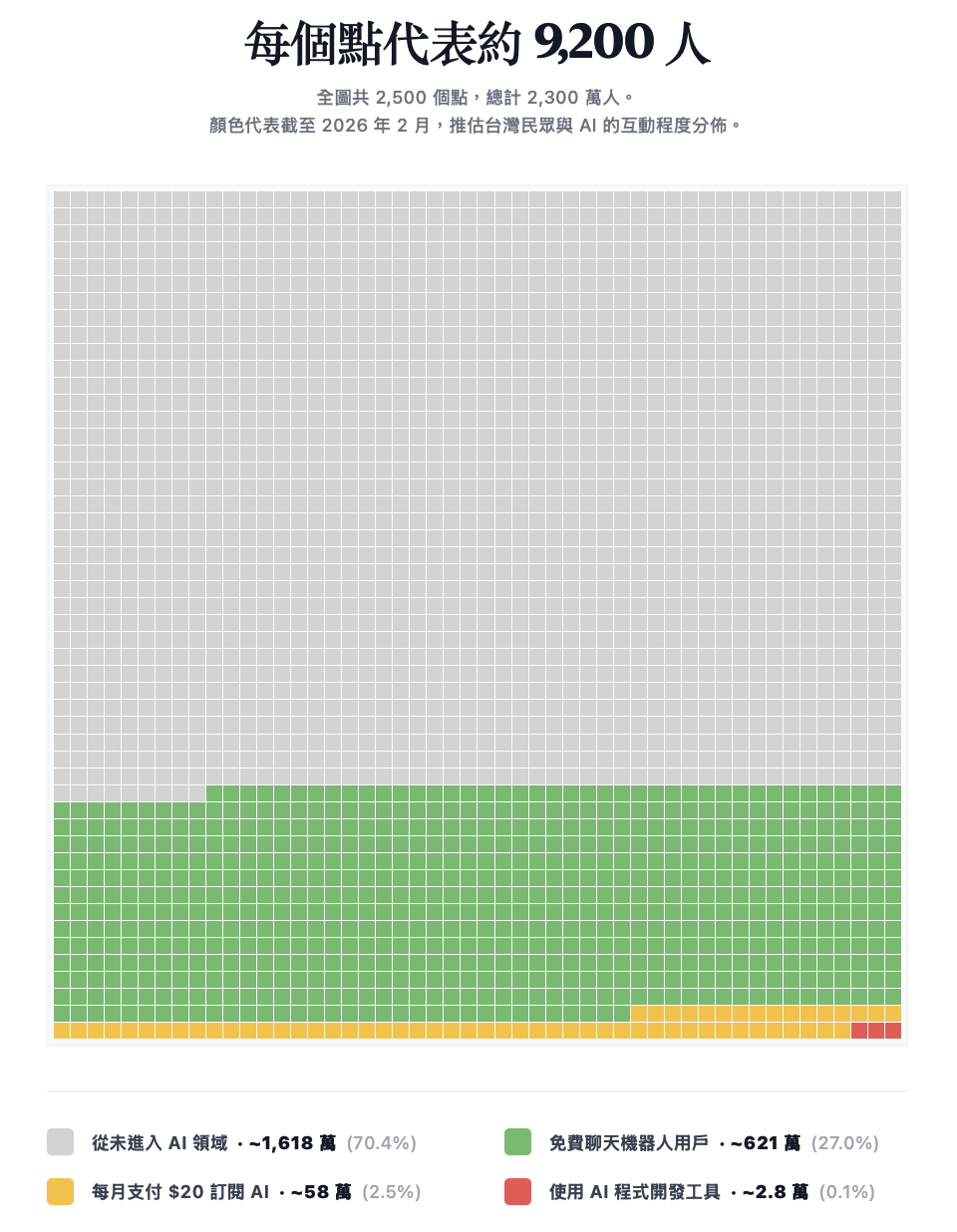
If you simply applied the global average of 0.04%, only about 9,200 of Taiwan’s 23 million people would use AI coding tools, which clearly underestimates it. Combining the “global average model” with the “Taiwan industrial structure model,” my conservative estimate is: the number of people in Taiwan currently in the AI coding tools tier falls roughly between 10,000 and 30,000, or about 0.04% to 0.13% of the total population.
Applying the same logic to revise Taiwan’s overall AI adoption landscape: the proportion of those who have “never used AI” is revised down to about 70%, “free chatbot users” revised up to about 27%, “paid AI subscribers” revised up to about 2.5%, and the topmost “users of AI coding tools” revised up to about 0.1%.
The Frontier of the Few, the Challenge of All
Taiwan did indeed cross into the AI era earlier than the global average. But those who truly stand at the frontmost tool chains and possess foundational creative ability, whether 30,000 or 60,000, remain a minority.
If you’re already on this path, don’t stop. If you haven’t started yet, it’s not too late to begin now. But wait any longer, and by the time you catch up, what you see may already be a completely different version.
Bosses, entrepreneurs, chief digital officers, department heads: how do you view your own enterprise’s transformation? What if the knowledge gap required to understand that transformation keeps growing wider? How do you plan to respond?
Original source: “There Are Levels to This: AI Adoption in 2026”, by John Crowley, published on Thayer Method.

💬 Comments
Loading...