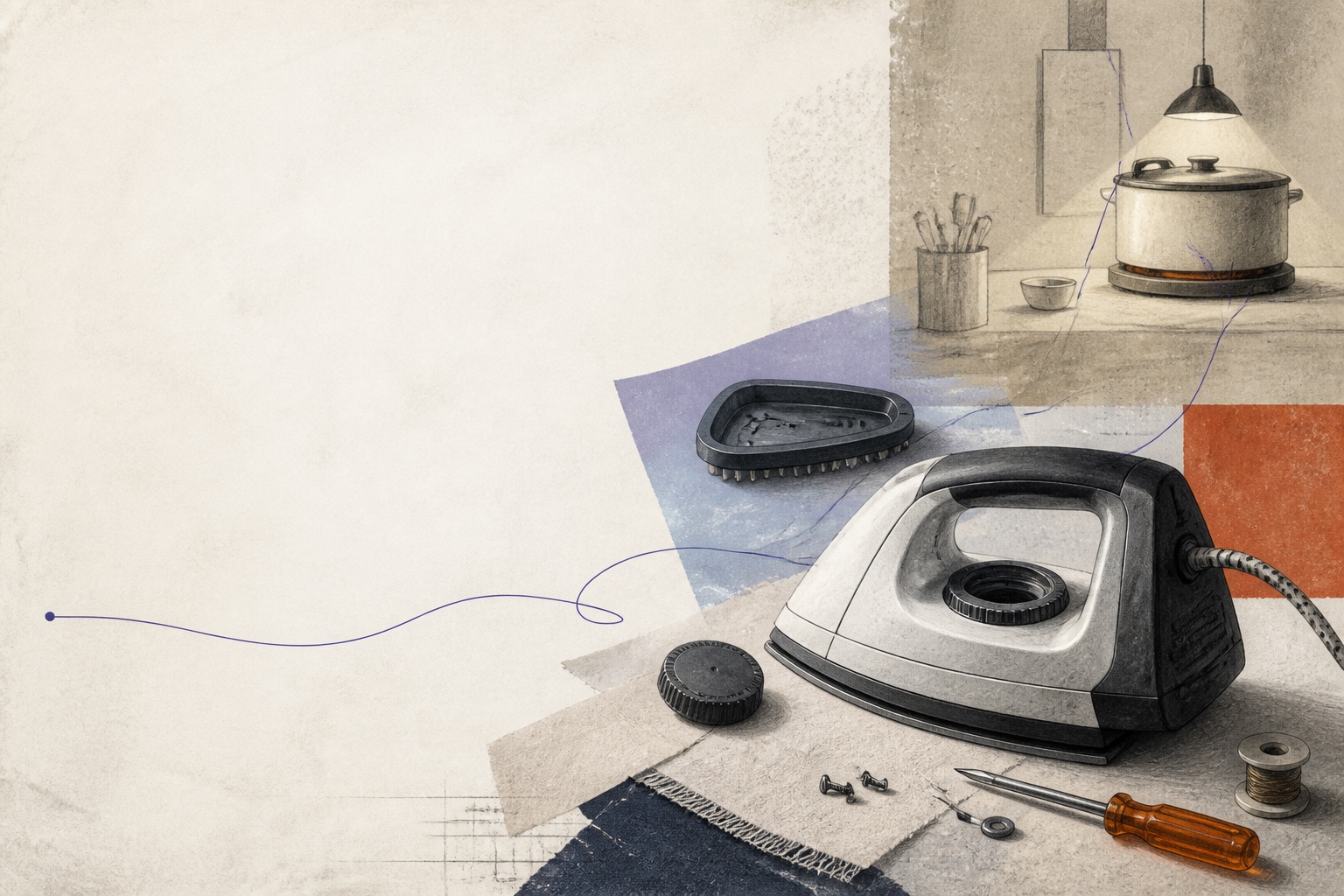

A professional organizer replaced the same category of appliance three times before finding one that actually worked for her.
The first was an entry-level model. Cheap, but prone to mineral buildup, and the heating knob failed roughly once a year. She cycled through units almost annually. She then switched to a mid-range machine. It didn’t break down, but the steam output was erratic. Every session became a small battle, so she eventually passed it on. Her work at the time required daily ironing. After going around in circles, she finally bought the professional-grade model she’d known from the beginning was right for her.
Three purchases combined had already cost more than the professional model would have from the start. Each intermediate choice had looked like a reasonable compromise: start cheap, upgrade if needed; try the mid-range, swap if it proves difficult. But every remediation left one more object in the home that needed handling.
“Doesn’t Work Well” Is Harder to Act On Than “Broken”
A malfunction sends a clear signal. Something won’t turn on, won’t heat, won’t run, and you know you have to repair or replace it. Poor fit sends no such signal. It just nags: a small snag each time, a moment of friction, a slight drag. Nothing ever rises to the level of “I must deal with this today.”
The cost accumulates inside that gray zone. Every frustrating session consumes a little extra time and a little extra patience. Neither shows up on a receipt, so neither gets factored into the next purchase comparison. By the time the user finally gives up, the use-cost of those preceding years has already been paid, and the original object is rarely easy to pass on.
The same organizer followed a nearly identical path with kitchen equipment. The first machine wasn’t unusable, but its processing sequence was poorly designed and ingredients kept sticking. The step-up model worked on the same principle and produced the same result. It wasn’t until the third that the problem was solved. Neither of the first two failed mechanically; from day one, neither matched how she actually cooked.
That gap is worth revisiting before any purchase: am I testing out a need I’m not yet sure about, or am I buying a tool I know I’ll use every day? The two situations call for different standards.
Remediation Isn’t Always Cheaper Than Choosing Again
After a bad purchase, the instinct is to fix rather than replace. Veneer a cabinet, swap the handles, add casters, repaint. If a machine is troublesome, buy an attachment, swap a consumable, find someone to modify it. Remediation sounds more economical than starting over, and it lets you avoid admitting the original judgment was off.
The problem is that the initial money is already gone. Each remediation adds new spending, and the room for improvement is capped by the original object’s design. Something fundamentally unsuited may still be unsuited after all the modifications, and eventually gets given away anyway. The money, time, and materials spent in between don’t disappear just because you eventually manage to pass it on.
Remediation isn’t wrong in itself. The real question is whether it can return the object to a state of long-term use, or whether it’s only buying a few more months. The first is repair; the second is sometimes just a delayed exit.
Whether It Can Be Repaired Determines Its Real Lifespan
One reason the professional-grade model was kept was that it could be repaired. That’s not the same as “you can send it in for service.” It requires that spare parts exist, that a qualified technician is accessible, that the repair cost is reasonable, and that the object still has enough useful life to justify fixing. Remove any one of those conditions and a broken item is often just not-yet-discarded.
Decluttering sessions routinely surface another version of this: family members who have kept a broken appliance alongside a bag of its parts, telling themselves they’ll get around to fixing it. Without a realistic window of time, the right tools, and an actual repair plan, that intention tends to leave the object occupying space indefinitely. Keeping the possibility of repair open is not the same as completing one. Judging an object’s real lifespan means asking honestly whether it can actually be returned to use.
The Faster the Turnover, the More Objects Need to Move On
One replacement per year is five appliances in five years. Over the same period, a single durable, repairable machine suited to its purpose might still be running.
Across ten decluttering cases, 580 bags of items were cleared. Of those, 195 were logged as donated, meaning a recipient was found under the conditions of that particular session. These cases are not a random sample and cannot be used to generalize across all households. What they do illustrate is that faster turnover means more objects needing to move on, and the secondhand market can only absorb so much, in so many forms.
Outdated styling, large footprint, difficult cleaning, or missing repair documentation all make appliances harder to place than clothing or small everyday items. Once you buy wrong, the cost isn’t just the extra money at point of purchase. It includes everything that follows: idle storage, cleaning, moving, finding a recipient, and final disposal.
Bring the Exit Path into the Purchase Decision
For objects used frequently, fit deserves more weight than lowest price. When the need is still uncertain, confirm the use context before committing to full specifications. Price and fit are separate questions and shouldn’t be collapsed into one.
Before buying, four questions are worth asking: In what specific situation will this actually be used? Does something in the home already serve this function? If it breaks, who can fix it and where are the parts? If it turns out not to work, who might realistically take it?
These questions aren’t meant to raise the bar for buying. They’re meant to look at the whole life of an object, not just the moment it comes through the door.
Circular economy principles don’t begin when an object is given away. The opportunity to reduce waste often comes before the purchase decision forms. Judgment at the demand side, about fit, repair access, and actual use context, shapes whether an object will need repeated remediation, sit idle, or exit early. One more complete evaluation upfront can mean fewer rounds of remediation and one fewer object that proves impossible to handle on the way out.
Before buying, be clear about one thing: is this a trial, or a long-term commitment? When the use context is wrong from the start, what people end up carrying is rarely just the cost of buying again. It’s the full freight of an object’s movement through time, most of which could have been avoided.

💬 Comments
Loading...