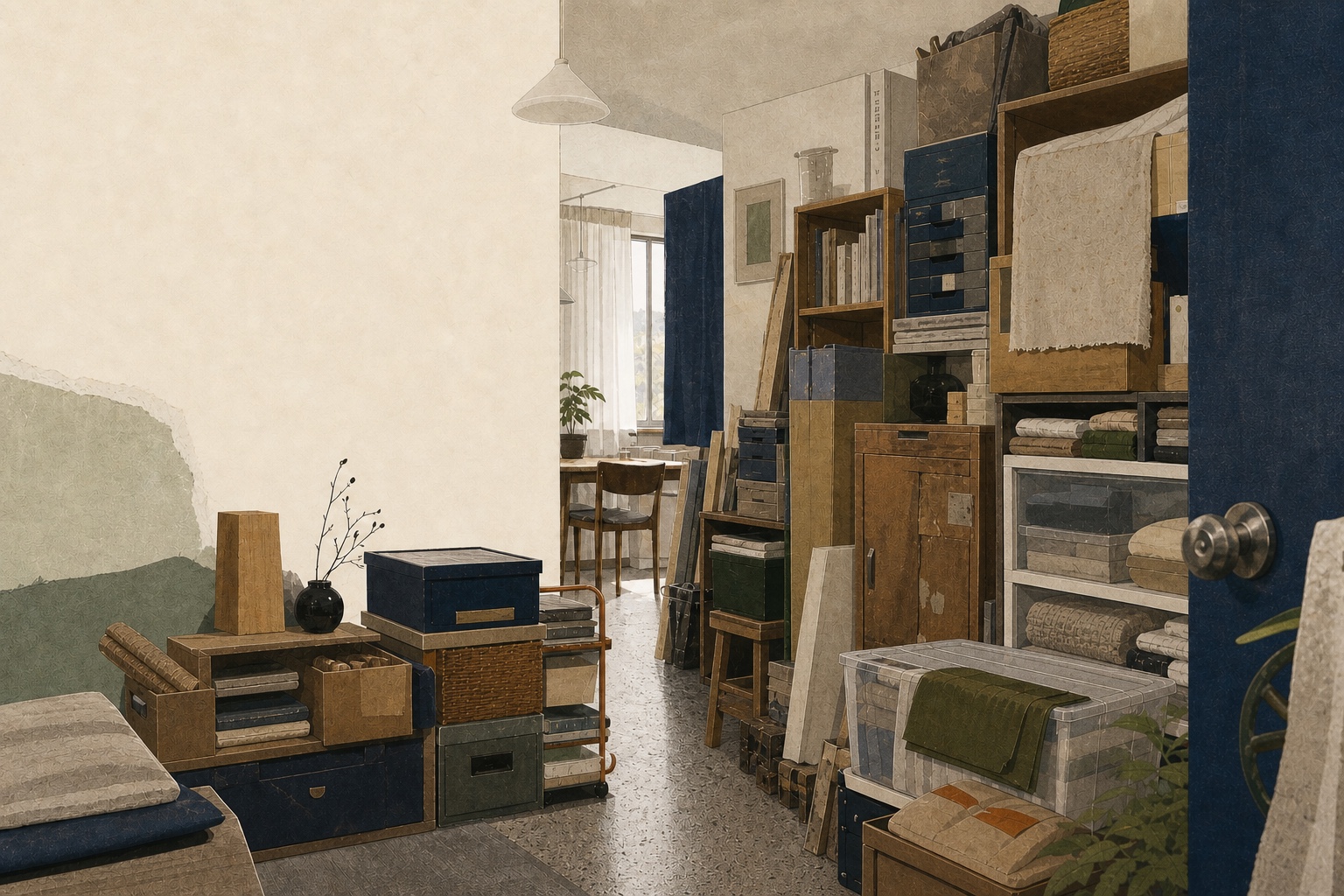

One father had bought more than ten books on home organization. He personally supervised the construction of a four-story townhouse, lived there with a family of five, and had far more rooms than anyone actually needed. He genuinely worked through the books and stayed up entire nights organizing. The next morning, looking around, he felt the house had “barely changed.” Eventually he brought in a professional team, who came in multiple sessions before they finally cleared the floors.
This case doesn’t prove that storage knowledge is useless. But it does rule out one common assumption: that a messy home is messy because the people in it don’t know the methods. When the number of objects exceeds what a space can hold, knowledge, square footage, and willpower may all fall short of closing that gap.
More Rooms Just Means Hitting the Wall Later
When people see disorder, the first instinct is usually that things aren’t put away properly. That instinct leads naturally to a particular solution: add a cabinet, buy some storage bins, learn a better way to fold clothes. This approach works when the number of objects is still within the space’s capacity. Once that threshold is crossed, the logic reverses.
Storage products are themselves objects. Bring a shelving unit into a room and the room’s usable space immediately shrinks by that much. If the volume of things going in doesn’t decrease, the result is simply “things don’t fit” plus one more cabinet.
A house with many rooms doesn’t escape this logic. It just postpones the discovery. Extra rooms provide more corners where things can be set down with a “I’ll deal with it later,” but they don’t automatically cause anyone to buy less. Once objects scatter across different floors, they also tend to lose any fixed home. Something placed here today gets moved to another room tomorrow, and eventually every room becomes a new staging area.
Overloaded Homes Grow Their Own Overflow Zones
Once objects exceed a home’s capacity, a remarkably stable pattern tends to set in. The wardrobe fills up, so clothes get hung on doorknobs. Clutter stacks up in front of cabinet doors, so the doors can’t open, so the things worn most often migrate to the edge of the bed. The bedside fills up, so a drawer unit is purchased, and stacking continues onto its top.
One four-square-meter room had taken this path to its end. A single bed, a storage cabinet packed with clothes, a wardrobe that wouldn’t open, a door hung with garments on every hook, plus a chest of drawers and two three-tier shelving units, objects stacked nearly to the ceiling. The bedroom door was blocked by a cabinet behind it. To enter, you had to turn sideways.
This wasn’t a room where organizing had never happened. A bag on the chair, documents stacked on the bag, a towel on the documents, clothes on top of that, small things from the market resting on everything else. Each layer had once been a genuine tidying effort. Added together, they produced a door that wouldn’t open.
Reduction First, Then Storage
Storage techniques aren’t the problem. The sequence is. A household workshop that had been shut down for years did in fact receive four chrome-plated iron shelving units from the organizing team, but those shelves only came in after a large quantity of oversized furniture had been cleared out and the traffic flow through the space had been rethought. In the first four days, the team removed twenty-three bags of rubbish, including eleven pieces of large furniture. Had the shelves arrived first, they would almost certainly have become a fifth staging area.
Another homeowner, who had just finished a long period of caregiving and was herself recovering from chemotherapy, found after organizing that two of the original shelving units in the study were no longer needed. They were dismantled, and no new storage was rushed in to fill the wall space. The session’s record showed twenty-eight bags of rubbish, thirty-six bags of recyclables, fifty-eight bags of items given to new owners, and one and a half truckloads of haul-away. When the total volume of objects drops, the need for storage drops with it.
These figures come from individual organizing cases, not a statistical sample of typical households. What they support is an observation about sequence: address total object count first, then assess how much containment is actually needed. Any solution that increases the total number of objects in a home will struggle to solve an overflow problem.
Manage the Door First, Then Figure Out Where Things Go
After a home is organized, the rules most likely to remain in place are “return things to their spot after use” and “every object has a place.” These address the inventory already inside and depend on everyone executing them every day. A more foundational rule, stop buying things that serve a function you already own, addresses the flow before it enters, and is a decision one person can make at the moment of purchase.
This isn’t a demand to refuse all new objects. It’s a checkpoint: does the house already have something that does this? Will this thing actually be used? If the answers aren’t clear, not adding one item is often more effective than buying a box to store it in later.
The first site of circular economy, as it turns out, is before anything gets thrown away. It asks us to first see what we already have, and then decide what stays, what gets repaired, what gets passed on, and what returns to material. Storage deals with location. Reduction and circulation deal with the fate of things.
A home becomes genuinely livable not because everything is hidden away, but because what remains has a clear purpose and what leaves has somewhere to go. Cabinets can help. They just shouldn’t be used as a substitute for deciding.

💬 Comments
Loading...