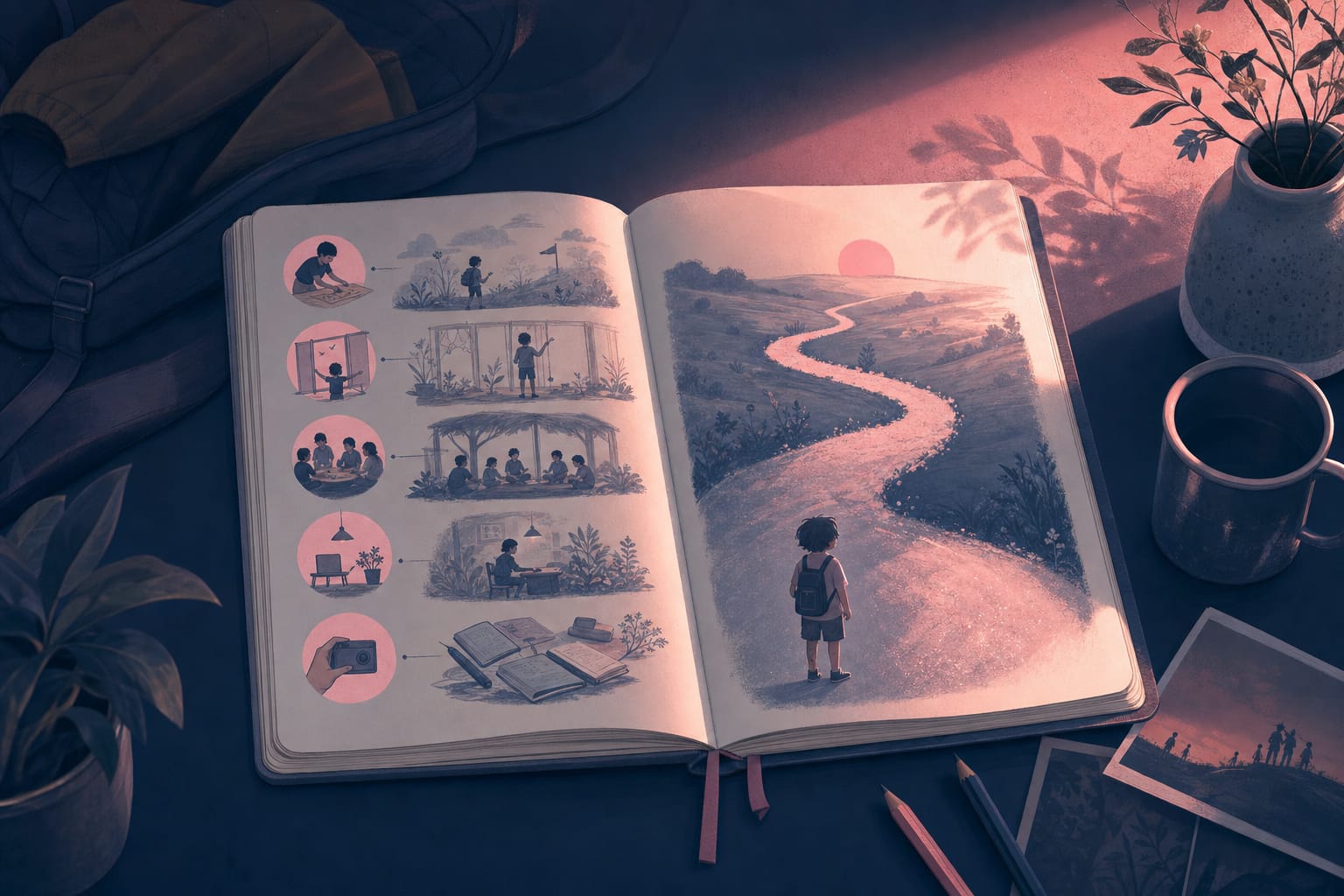
TL;DR: This is the closing summary of ten years of educational practice, along with five design principles genuinely worth taking home: give children real tasks, put freedom inside structure, design group experiences deliberately, let adults be learning-environment designers, and preserve evidence of capability from day one. Behind each principle are stories that actually happened inside this series, including the parts that didn’t work and had to be rethought. These principles are yours to borrow, but every family faces a different child, different resources, and a different context. The actual path is still yours to design.
This is where the series ends.
A decade of archives. Over 2,300 files. More than twenty articles. It began with the overview essay “From Flip to Climb” and wound through e-commerce sites, the Kumano Kodō, camps, mentor contracts, cost ledgers, and learning portfolios, and through the less flattering parts too: student work that got taken away, 142 hours of invisible labor, the loneliness of having too few peers nearby.
For this final piece, I want to compress the whole practice into five principles. One criterion guided the compression: can another family actually take this home? Whatever couldn’t travel (our particular circumstances, our luck, the specific moment in time) stays as story, not principle.
Principle 1: Give Children Real Tasks
A real task must have purpose, audience, deadline, a deliverable, and a genuine possibility of failure. Subtract any one of those five and it slides back into a simulated exercise.
The most complete example in this series is “Four Kids, One Summer, One Website That Had to Go Live.” The site had to actually launch, for real users, with the end of summer as a hard deadline. The most important growth happened during the two weeks the children sat stuck in front of a blank page. A test carves the problem into bounded, labeled pieces; a real task throws technology, narrative, commerce, and collaboration at you all at once.
Ten years on, AI turned this principle from an educational philosophy into a practical necessity. “When Assignments Can Be Generated, Why Real Tasks Matter More” is about exactly that: when any written assignment can be produced on demand, actually doing something inside a real situation becomes one of the few forms of capability that cannot be faked.
Principle 2: Put Freedom Inside Structure
Flipping the classroom opens up freedom, but freedom is not the destination of education; it’s the starting point of design. Freedom without structure usually produces only drift.
What does structure look like? Rhythm, records, feedback, revision. The experimental-education plan submitted to the review board in “From Homeschooling to Special Admission” (plus the thirty-plus-page annual outcome report) looked like administrative overhead. It was actually the scaffolding that held the freedom upright. “The Hard Test of Learning Through a Shutdown” is the counterexample: the moment structure disappeared overnight, the families who collapsed first were precisely those who assumed children would learn naturally on their own.
This principle cuts both ways. All structure and no freedom is just standardized control in different packaging. Where to draw the line is discussed in “After AI Speeds Up Learning, Where Do Children Practice Slowing Down?”: the task is distinguishing which friction is waste and which friction is the learning itself.
Principle 3: Design Group Experiences Deliberately
Collaboration, compromise, conflict resolution, and accountability are hard to develop through solitary practice alone. They form through repeated friction in a world with other people. “Emotions Happen Inside Relationships” covers the relational side; “The End of the Solo Runner” supplies the sharpest example: one person drops out of a relay, the whole team is disqualified.
Group experiences don’t arise on their own, especially for this generation. “Camps and Experiential Education” unpacks a 2015 camp schedule: the wall in the obstacle course was set just high enough that no one could clear it alone. A shared fate was designed, not assumed. First subtract, and bring children back into the real world; then add, and give them something they can only finish together.
Principle 4: Let Adults Be Learning-Environment Designers
The work of parents, teachers, and mentors is not mainly to supply answers. It is to shape the context, ask probing questions, provide resources, and hold boundaries.
This series spent three articles on the cost of holding boundaries, because it’s the part most likely to be glossed over by a romanticized telling. “The Hidden Ledger of Educational Innovation” counted the cost: one impressive outcome, 142 hours behind it. “How to Find a Mentor” laid out the screening form, the declaration, the contract, and the letter of appointment. “Who Owns What a Child Makes” documents the time a boundary wasn’t held: a student’s unpaid output was monetized because no one had established in advance whose it was.
Adults who bring children into the real world must first bring the real world’s rules in with them. Trust is precious, and precisely because it is, it needs guardrails.
Principle 5: Preserve Evidence of Capability from Day One
Work, records, feedback, reflection: preserve them from the very beginning, because a meaningful learning portfolio is built up over time. It cannot be reconstructed after the fact.
“Ten Years on Seesaw” traces how a learning archive of 1,585 files grew: it was a byproduct of teaching; no one stayed late to build it for an application. “The Craft of Translating a Portfolio” describes how it was eventually organized into language institutions could read. “Learning Portfolio vs. AI-Generated Résumé” explains why this matters more in the AI era: timestamps and process density are evidence that cannot be generated after the fact.
Of the five principles, this one has the lowest threshold. You can start today. One folder, one platform with timestamps, one habit of recording what’s real, including the failures.
Beyond the Principles: Paths Cannot Be Copied
The most important thing to say here sits outside the five principles.
Someone else’s story is not a template to transplant directly. Every case in this series grew inside a specific child, a specific family situation, a specific moment in time. Non-traditional education depends heavily on how much time and how many resources a family can invest. That is an honest limitation. I’ve returned to it throughout the series; I don’t want to pretend it away in the closing.
So the right way to use these five principles: as a map to consult, not a recipe to follow. They answer the question “in which directions should I design?”, not “do this and it will work.” Every child’s path still needs to be designed again, for that child.
When we started ten years ago, this map didn’t exist. Now it does. The transferable parts are all here. The road ahead belongs to you and your child (your own Canaan), and you get to build it yourselves.
💬 Comments
Loading...